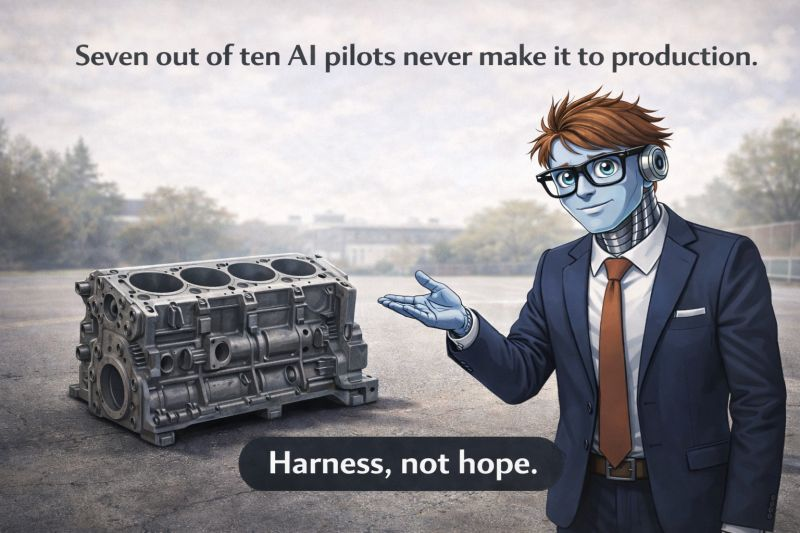
Seven out of ten AI pilots never make it to production.
The models keep getting better. The failure rate has not moved.
That is not a model problem. It is an engineering problem.
Why most pilots skip the engineering step
Every pilot playbook treats model access as the hard part. Procure the API key, enable the seats, run a kickoff, collect feedback. The technology is the point; the operating discipline is whatever the team figures out along the way.
That order is inverted. The model is a commodity. The discipline around it is not.
Coding agents amplify whatever you feed them. A vague request produces confident, plausible output that is subtly wrong in ways a human reviewer will miss on a tight deadline. A written specification with explicit input and output contracts, acceptance criteria, and boundary behavior produces output you can validate against something concrete. Same model, same week — different economics.
Pilots fail when teams treat prompts as instructions and outputs as deliverables. Prompts are ephemeral. They live in a chat window and disappear when the conversation ends. A specification is a versioned file, revised when requirements change, diffed when implementations drift, and reused every time the code is regenerated. One is a demo. The other is a system.
What pilot-failure mode looks like from the outside
- Demos are impressive. Second runs are inconsistent. Nobody can reproduce last week's good result.
- Rework costs climb. Every agent output requires a human to clean it up before it lands.
- The team blames the model. Every conversation ends with "this will get better when the next release drops."
- There is no artifact you could hand to a new engineer that would let them run the same loop tomorrow.
- Leadership concludes the technology is not ready. What actually failed is the operating model around it.
If any three of those describe your program, you are not running a pilot. You are running a demo on loop.
What the harness actually looks like
The harness is not a tool. It is the discipline that makes good output repeatable.
In February 2026, OpenAI published a case study on a team of three engineers — later seven — that shipped roughly one million lines of production code in five months without writing a line by hand. Every line was generated by coding agents. The engineers' job was what they called harness engineering: designing the codebase structure, writing specifications, encoding architectural constraints as automated rules, and building validation pipelines that caught agent mistakes before they reached production.
Three things define that harness in practice.
A specification as the source of truth. For every component the agent touches, there is a Markdown file in version control that defines the input contract, the output contract, the acceptance criteria, and the edge cases. When the output is wrong, you fix the specification, not the generated code. Fixing the code addresses the symptom. Fixing the specification addresses the cause — and every future generation respects the fix.
Deterministic validation on top of probabilistic generation. The agent's interpretation of the specification is probabilistic. The validation that follows is not. Test suites return pass or fail. Type checkers accept or reject. Linters flag or approve. A guard condition gates deployment: if any check fails, the implementation is rejected and the specification is revised. The spec defines intent. The tools enforce it.
Parallel, multi-dimensional review. Where a traditional team runs sequential human reviews bounded by attention and deadline pressure, a harnessed team fans out analysis agents in parallel: security review, performance profiling, test coverage, maintainability. A reducer merges the findings. Nothing skips the performance check because someone is tired on Friday. The review is more thorough than human review because it runs every analysis every time, with no fatigue and no shortcuts.
That is the difference between "we have an AI pilot" and "we have a production AI system." It is not a model. It is a harness.
What to do Monday
Pick one component from your pilot and write a specification before anything else. Input contract, output contract, acceptance criteria, three example input-output pairs, two edge cases. Direct the agent to implement from the spec. Validate the output against the spec. That is one turn of the loop you should be running on every piece of work.
Add automated validation that the agent must pass, not you. Tests, type checks, linters, a security scan. Make the validation pipeline the gate. If a human has to read every diff line by line before it lands, you have not industrialized anything.
Track iterations-per-specification. Count how many times you revise a spec before its output passes. That number tells you whether your specifications or your validation are the weakest link, and it replaces "how's the pilot going?" with a metric leadership can actually read.
The discipline, not the demo
Harness, not hope.
The organizations that scale AI are not the ones with the most pilot activity. They are the ones engineering the system that makes good output repeatable.
AI changes software economics only when leadership changes the operating model around how these systems are built, validated, and scaled.
Are you still hoping the next model will fix it?