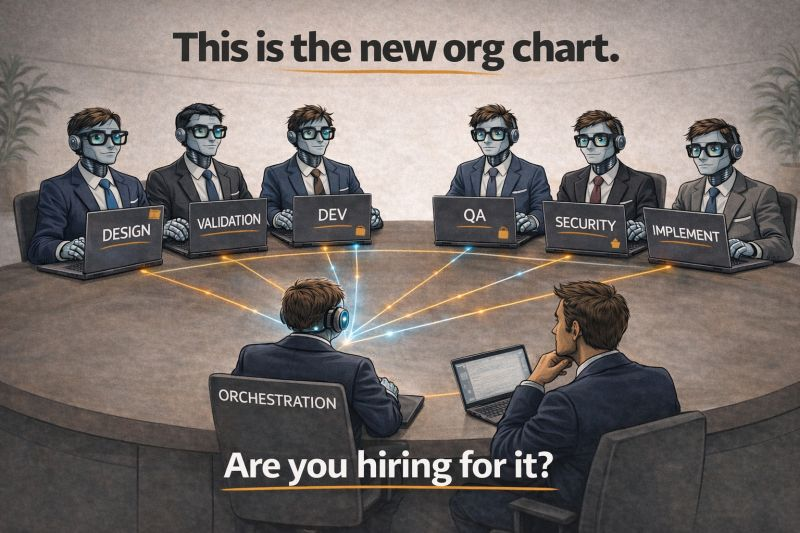
Your org chart still assumes humans are the implementation layer.
That assumption is about to get expensive.
Every software org was designed around one idea: people write the code. Now AI can.
Why the old org chart looks the way it does
Every org chart you have ever worked inside was drawn to solve one scarcity problem: implementation capacity. Humans type code slowly, so you needed a lot of them. You needed managers to coordinate the lot of them, tech leads to hold the interfaces together, and engineering managers to hold the tech leads together. Each box on the chart is a claim on scarce implementation hours.
That scarcity has collapsed. A coding agent with a well-written specification generates in an afternoon what used to take a two-week sprint. The engineers OpenAI described in their February 2026 case study — three, then seven — shipped roughly one million lines of production code in five months. They were not staffed for implementation at all. They were staffed for specification, delegation, and validation. Throughput grew as the team grew, in direct contradiction to Brooks' Law, because the coordination cost sat in the harness rather than in meetings.
If implementation is no longer the bottleneck, the chart drawn around that bottleneck is the wrong chart.
The ratio of architects to implementers is inverting.
What the new role actually does
Call it the Architect-CEO. The name is the job description.
An Architect-CEO does three things, over and over, on every unit of work:
- Specifies what should be built — the input contract, the output contract, the acceptance criteria, the edge cases.
- Directs the system that builds it — assigning the task to a coding agent, or a fleet of them, with the context and constraints the agent needs to succeed.
- Validates that what the system built is correct — through automated checks, not by hand-reading diffs.
That is the loop. It is the same loop a CEO runs inside a company: define outcomes, delegate, verify. The coding agent is the executor. The architect is the one deciding what "done" means and who does what.
The discipline that makes this role work is not typing speed. It is the same set of coordination primitives that structure any high-functioning team, compressed into one person's operating model: discovery (which agent, with which capability, is available?), messaging (what structured context crosses the boundary between you and that agent?), and delegation (who has the task, how long do they have, what happens when they fail?). Every multi-agent system must solve those three concerns. Every new-shape engineering org will too, whether the leadership names it that way or not.
The structural implications — not cosmetic ones
This is not a rebrand. The operating model actually changes.
Specifications replace handoffs. The thing a junior engineer used to receive from a senior engineer — a Jira ticket, a paragraph in Slack, a whiteboard sketch — becomes a versioned Markdown file with explicit contracts. The agent reads the spec; the spec is the handoff. There is no drift between what was asked for and what was implemented, because the asked-for is the document the implementation is regenerated from.
Validation replaces supervision. The thing a tech lead used to do — read a pull request, eyeball the code, approve it — becomes an automated pipeline: type checks, tests, security scans, maintainability reviews, performance profiles, each running in parallel on every diff. A human reviewer gates escalations. The pipeline gates everything else. The validation pipeline is the supervision layer.
Orchestration replaces inter-team coordination. The thing a program manager used to do — wire three teams together, manage the dependencies, chase the status updates — becomes a workflow graph with typed messages crossing its edges. Fan-out to parallel agents. Reducers that merge their outputs. Correlation IDs that trace every handoff end-to-end. The orchestrator runs the coordination protocol. The protocol is the program manager.
Anthropic's multi-agent research made the mechanism concrete. A lead agent decomposed a complex task into subtasks, each specified with an explicit objective, output format, and boundary. Subagents executed in parallel and returned condensed findings. Versus a single agent on breadth-first queries, the result was a 90% performance uplift — but only when the handoffs between agents were typed and structured. When the same team tried unstructured natural-language handoffs, the coordination quality collapsed. Structure was not overhead. Structure was the reason it worked.
None of this means fewer people. It means different people, doing different work, with dramatically more leverage per head.
What "hiring for the old org chart" looks like
- Job reqs counted in "engineering years" rather than specification and validation fluency.
- Seniority ladders where the top rung is measured in code review volume or lines shipped.
- Orgs hiring ten "AI-assisted developers" when they need one architect-CEO and a harness.
- Leadership expecting a productivity uplift from tools without touching the reporting structure, the definition of done, or the way work gets handed off.
If any of those describe your program, you are buying the tool without buying the operating model. The first will not work without the second.
What to do this week
Pick one flow and redraw it as a coordination graph. Who specifies, who directs, who validates, and how does work move between them? If the answer is "a senior engineer does all three by hand," that is the role to redesign.
Stop hiring for implementation. Start hiring for the harness. Your next requisition should be written around the ability to specify behavior, design validation pipelines, and reason about delegation — not around languages and frameworks.
Name the architect-CEO role on a real team and measure what they ship. Not lines of code. Specifications authored. Workflows orchestrated. Validation pipelines tightened. Time-to-deployment for a typical feature. The metrics have to change for the operating model to change.
The operating model, not the tool
Instead of assigning five engineers to build a feature, one person defines the spec, sets constraints, and evaluates outputs from AI systems.
Specifications replace handoffs. Validation replaces supervision. Orchestration replaces the coordination that used to happen between people.
This is not downsizing. It is an operating model shift.
Engineers who learn to specify, direct, and validate become dramatically more valuable. But only if leadership redesigns the system around that role.
AI doesn't change software economics on its own. The org chart does.
Are you still hiring for the old org chart?